
Believers and the misunderstood
Prelude: What constitutes the "main" section was posted earlier today in my Substack "Notes."
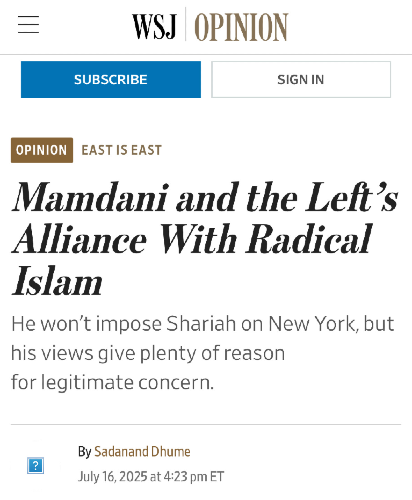
Last week, an op-ed writer for the Wall Street Journal wrote an opinion with this headline
Now, this is the same op-ed writer who shared this with his readers this past February:
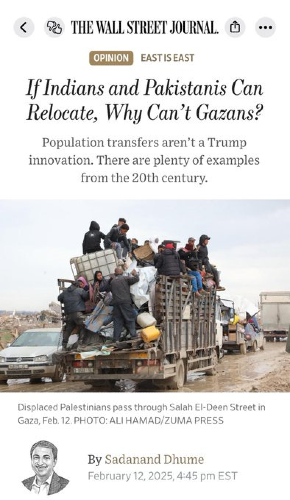
I cannot read any of Sadanand Dhume's op-eds because they are behind a paywall, but the headlines say a lot. The one about Indians and Pakistanis "being able" to relocate was very infuriating in large part because for more than a few of us, this "population transfer" affected "Indians and Pakistanis" in ways that still inform our relationship with one another. Not only between the two countries but within, between Hindus and Muslims. Not all of them wanted to move. Many of them had to. There wasn't always a choice. It was leave, or die. Or rather, live or die. And many of them died in the process of leaving. It was one of the most violent population transfers of the 20th century.
Many Palestinians relocated because they had to. The Nakba forced them to do so. The diaspora is spread out across oceans and seas. The ones who remain, do so because it is their home. It has been their home. Even if they could leave, why should they?
I realize that I do not define words like "Islamist" and "Radical Islam," and perhaps I make the same mistake Dhume does, or maybe not, because I know the difference between an Islamist and a Muslim. I'm not sure that Dhume does. As a non-Muslim, I want to be careful, as well. But let me try, based on what I know and have experienced living among Muslims.
An Islamist is a Muslim, yes. But an Islamist also desires that Islam should go beyond the personal, and be the way through which political and social structures operate as well.
Not all Muslims are Islamists. Not all Muslims are out to convert us to Islam. A Muslim can be strong in their faith and not be an Islamist.
And yes, Islamism can be just as dangerous as Christian Nationalism. And both have been harmful.
The thing we do not see, when we don't get to learn from one another, are the commonalities we do share as Christians and Muslims. We have been able to live with one another when we do see and learn from one another.
Zohran Kwame Mamdani is Muslim. And while his faith may guide aspects of his life, it does not translate to all the fears certain people keep stoking with words like "sharia" and "Radical Islam."
. . . . .
Main: When I see a headline like “Mamdani and the Left’s Alliance with Radical Islam,” the dog whistles are overwhelming. Now I get that the op-ed writers don’t always choose their headlines (or so they say), but already, for more than a few (read Islamophobic or borderline), just those words already signal something. What does “Radical Islam” mean to us, or what has it looked like? Because to more than a few, just being a Muslim is radical in itself. Here many of us as Christians, are separating ourselves from Christian Nationalism. But we can’t grant as many Muslims doing the same within their faith? Make that make sense to me. And it isn’t just other faith practices that misuse the word Islamists, or lump a chunk of Muslim communities into “Radical Islam.” It’s atheists like the late Christopher Hitchens, and Sadanand Dhume, among others. I do not fault atheists for being critical of religion. There is room for everyone in this world. I do fault atheists for doing it dangerously. Especially those ones who are prominent, or have a wider audience like Hitchens did. And Christians may not be on the same page as atheists, but it seems a lot of them sure as hell are when it comes to how they see Muslims.
For a number of years, when mob attacks on Christians were happening in Pakistan more often than they did when I was growing up there. I was outraged. At the people who did it. At state apparatuses for not doing more to curb the attacks. Angrier because of all the destruction done to my mother’s village which I spent time in and loved. I vowed never to return to Pakistan again. But it didn’t make me Islamophobic. Because I had wonderful memories of Muslim friends caring for us throughout the time I lived there. And Muslims who came to the aid of other Christian communities that faced attacks. And Muslim friends here in the US who showed me love, care, and hospitality.
And they are NOT the exception.
Mum shared an anecdote once about one of her White American friends who was bashing Mexicans (read: brown immigrants), and Mum reminded her that she’s (Mum’s) an immigrant. To which her friend responded, “but you’re not like them.” And Mum was stunned. She did not take that as a compliment.
Because it shouldn’t be one.
Because we shouldn’t accept attacks on groups of people even if “we’re not like them.” If we cannot hold mirrors up to ourselves and remove the metaphorical log-like cataracts from our eyes.
Because we are more like them than we know or care to know.
Islamophobia is still rampant in the US. Muslims who have recently immigrated, or arrived as refugees, and Muslim-Americans have made their homes here. I wish we were more open to widening our collective vision, and our hearts and minds.
. . . . .
Postlude: I want to go back to Sadanand Dhume's op-ed using Partition as an example of "population transfer." When I see the images and read about the Israeli military killing Palestinian children, I cannot help but think of the Armenian Genocide which the Turkish government denies to this very day ("it wasn't genocide, it was part of WWI."). The death marches. That, too, was a "population transfer." Not by choice. Ethnic cleansing is ethnic cleansing, my friends. Palestinians and external agencies are not the ones holding back food and aid. The Israeli government is starving them. It is absolutely unbearable to see pictures of people who are barely skin and mostly bone. Of images of children crying in hospitals that have been bombed. These pictures and videos are for us to remember. For the world to see. These are part of the Substack algorithm I see, more than anything else. And when one asks a question that sounds almost casual, as if Gazans could just leave. As if Palestinians would have lived had they not left . . . .
It becomes very hard to respect the dignity of all those who pose such questions, and ignore this. To live with the inhumanity of those committing genocide. But live we must. And remember. And truly mean "Never Again."