
From there to here
Some of this may be repetitious for those of you who have followed me or subscribed to my Substack. If so, please feel free to skip it.
. . . . .
It is difficult for me in these times not to think of 1977. More than a bit of what happened that year is still vivid in my memory. And I don't want to forget it for as long as I possibly can, because the years from 1977 to 1979 are a huge part of what has informed my politics.
I don't want to go into an extensive history of Pakistan, but suffice it to say that contrary to what many believe on both sides of the border, it was established as a secular nation, it having been carved up on the basis of religion notwithstanding. Mohammad Ali Jinnah, the founder of the nation, may have tried to appease the mullahs and religiosos as every leader has done, or tried to do since, but his intent was for Pakistan to be secular. Pakistanis who still advocate for a secular democracy believe that based on his words, including his first address to the Constituent Assembly of Pakistan, here, and using this passage in particular:
Therefore, we must learn a lesson from this. You are free; you are free to go to your temples, you are free to go to your mosques or to any other place or worship in this State of Pakistan. You may belong to any religion or caste or creed – that has nothing to do with the business of the State.
Jinnah went on to say that our ideal was that in terms of the State, Muslims would no longer be Muslims, and Hindus would no longer be Hindus, with emphasis that that did not apply to our personal faith. But that was not how a number of Muslims saw it even then.
Reading this address today, although Jinnah may have had the best of intentions, I can't help but note a certain naïveté, intentional or not in some of his words. And I think the Irish would disagree about what he said about Great Britain in the same paragraph as the quote above.
. . . . .
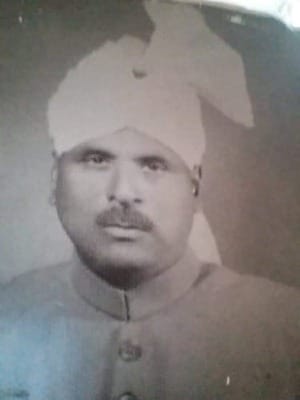
In 1969, we were in Rochester, Minnesota where our father was finishing up post-graduate work in surgery at the Mayo Clinic. That year is one of my first memories of the realization that we were not American, but from another country. There is a lot about my first four years, and part of the fifth that I do not recall, perhaps in part due to my difficulties as a result of spina bifida. Bits and pieces, yes, but nothing to do with knowing that all of us were born in Pakistan, with the exception of our youngest brother. I don't recall our parents ever speaking to us in Urdu or Punjabi, let alone to one another. And yet, our ethnicity could be seen in the small framed photograph of Nanaji (maternal grandfather):
The other picture of a Pakistani, besides those of us in our rooms, was that of President Ayub Khan, who overthrew the then President of Pakistan, Iskander Mirza (who himself had declared martial law) in a coup. I'm uncertain as to why my parents had that picture on one of our walls. Mum told me it was from an old calendar, and I'd hate to think that my parents supported a dictator. Benji, possibly, but not Mum. But I digress, as I am wont to do. In 1969, on Christmas day, I saw a card with writing in a script I did not recognize. I learned that it was from one of my relatives, either Nanaji or Mum's youngest brother.
In 1970, we would return to Pakistan, to the city of my birth, Lahore. Any Urdu my 2 year old sister and 1 year old brother may have known before we left for Minnesota was forgotten. My youngest brother and I knew next to nothing ourselves. We were back home, but it was foreign to us. We'd have to begin from scratch. We'd have to learn Urdu in order to be in schools that weren't American or International. And that was a Sisyphean task. Our older siblings would ultimately attend an International school because they couldn't master reading or writing in Urdu, while our youngest brother and I remained in schools that were English medium, but where Urdu was taught.
We got two newspapers at home. One in Urdu, the other in English. I tried to read the English one daily, The Pakistan Times. The first editor of the paper was the poet, Faiz Ahmad Faiz. Every time Benji would mention Faiz later on in life, he'd say to me, he was a communist, you know? He may have liked his poetry, but hated his politics. I didn't understand a lot of what the news was about, even during the 1971 war. The war that changed the face of Pakistan when the East Wing became Bangladesh, the war that brought us the leadership of Zulfikar Ali Bhutto.
Bhutto was a charismatic figure. He gave fiery speeches, with foul language for his enemies. The slogan he used "Bread, Clothing, and Shelter," was also used by Indira Gandhi, and he was able to rally people from various social classes. He was a popular leader. I used to love watching him on television as a child, or listen to what I thought was passion in his voice as he addressed the National Assembly. As his leadership continued, I did not know much about the changes he was making. I didn't know of how he approved of violent means to silence some who opposed his policies. I did know though that he was appeasing the Islamist parties, because that was how Friday would be our day away from school rather than Sunday. He was trying to hold on to power, and lead a nation. While I remained clueless about his shift in policies, I still felt that progress was in the works. Women seemed to have more freedom. It felt more like a democracy, as I remembered it.
My sister had various quotes on the wall in our bedroom, and one of them was,
Democracy is the government of the people, by the people, for the people,
attributed to Abraham Lincoln. And as I saw that, I hoped that was what ours was. I wished for it.
But it was not to be.
. . . . .
What I remember about hearing of the overthrow of Zulfikar Ali Bhutto in yet another coup, was being in a darkened room in our house, and the total silence that enveloped me as I tried to take it all in. It was the summer of 1977. Yes, we have arrived at 1977, through quite the winding road. I cannot recall whether it was around the same time as the death of Naniji (maternal grandmother). I always thought Naniji had transitioned in May, but it had to be July because that's when we were stopped on our way to her funeral, for car searches. Because with a coup, comes fear when grasping on to power.
The man whom Zulfikar Ali Bhutto overlooked other officers to make the Army Chief of Staff, Zia ul-Haq, orchestrated the coup. There had been unrest in the country after the elections early in 1977. I do remember accusations of the election having been rigged, given that Bhutto and the Pakistan People's Party won against the more conservative Islamist parties. Before Bhutto could make any more concessions to the Conservatives, Zia rushed in and engineered a coup.
I don't remember much about his initial announcement, although I've seen it on YouTube in recent years, but I do remember his press conference where he announced the changes that were going to take place. I was the only one watching it at home, and as he spoke of his Islamicization (I prefer the British spelling) policies, he wanted to assure us non-Muslims, us minorities, that our rights, such as they were, would be respected. As soon as he said that, he suggested that we as non-Muslims should convert to Islam, and he expounded on the beauty of the faith.
I was flabbergasted! Don't get me wrong. I sat through Islamic Studies (Islamiyat) classes through much of my schooling. I didn't think I had an option not to. And I learned a lot. I could recite a couple of Surahs by the fourth grade. And I found nothing wrong with Islam as it was taught, the ideas, its pillars. But listening to the man I would refer to as the kohl-rimmed dictator through much of my adulthood, the sickeningly sincere manner in which he said that, I doubted very much that we would be as valued as he said we would be as Christians, as Hindus. It was bad enough that I faced prejudice (and I believe, discrimination) from some at a school where the majority of students were Muslim. If those words came from his mouth, they would emanate from others as well. Again, my issue was not with Islam, but giving up our right to be what we had been for generations.
Not too long after he assumed power, Zia announced that severe punishments would occur for those penalized for certain crimes. I remember The Pakistan Times dedicated a page or more to all the crimes, and the punishments were mostly floggings, or lashes. The number of lashes varied with the crime. It was horrific to read that. It was awful to learn that a young woman was slapped in a bakery, in public for being with a man, who just so happened to be related to her. For many conservatives, their moment had arrived. For those of us who were more progressive socially and politically, our opposition to the government would have consequences. I was 13 in 1977. Zia's promise to hold elections within 90 days was a lie. As we students lived through these tumultuous times, some of my schoolmates engaged in arguments during recess. Such passionate arguments resulted in the Director banning any discussion of politics on school grounds.
When Zia came to power, he amended what Constitution was put together in 1973, the court system changed to incorporate the "Islamic" laws he enforced, the news was more the mouthpiece of the government (it always may have been). And more draconian laws would follow, but we left Pakistan in March of 1979. We were in Canada, the morning we learned that Zulfikar Ali Bhutto had been hanged after being convicted of a political murder a number of us do not believe he committed.
When Mum, my sister, and I returned to Pakistan in the summer of 1983, Zia was still in power. And there was furor over the punishment meted out to a visually impaired young woman whom her male employers raped. According to the law at the time, a woman had to present four male witnesses in order for the men to be charged. Since the woman was unable to do so, she was charged and convicted of the crime of fornication (zina) based on her being unmarried, and as I would learn later, pregnant. I was glad to see protests from women in the Letters to the Editor in The Pakistan Times, which Mum's sister still subscribed to. It gave me some hope that not all voices were silenced.
The atmosphere in Lahore though had changed. We were encouraged to go out with our heads covered, which Mum and my sister refused to do. It resulted in them being chased on one occasion when they were out. I did not feel like going out very much, which for someone who was visiting after 4 years may have been strange. But the switch from going out alone wherever and whenever I pleased while at uni in the US to having to be accompanied, and only if I dressed a certain way, plus in the blazing heat was not appealing. I much preferred spending time with my cousins, indoors.
When I learned of Zia's death in 1988, I jumped around the family room for joy, much to the horror of Mum, who didn't care for the man herself, but also did not approve of such raucous celebrations of death, no matter how awful the person was. Decades later, his shadow still haunts Pakistan, but a number of the laws have changed for the better, over a period of time, including the ones penalizing women. The misuse of the blasphemy laws continues though. Women continue to march and protest against a patriarchal system, and continue to infuriate conservatives with "My body, my choice" placards. True democracy remains elusive.
. . . . .
Tonight, as I sit at my desk and type this, the Palestinian genocide continues, aided by the US. A cease-fire between Iran and Israel is in effect. ICE continues their brutal raids, but not without resistance. The Executive branch of the US, supported by the Republican majority (and some idiotic Democrats) in the legislature, and the Supreme Court, continue on an authoritarian path, with little regard as to who lives or who dies (unless it's a billionaire, perhaps).
One does not have to have lived under a dictatorship to recognize one, or the beginnings of one, but for me, the years I spent in Pakistan, especially between 1977 and 1979 had a major impact on me politically. I mistakenly and very briefly applauded yet another coup in Pakistan by General Musharraf, only to realize he was a dictator like all the military dictators before him. Accountability and the promise of elections meant little to them.
Accountability means little to the present government here in the US. They want to keep referring back to the Biden years. I voted for Biden so the occupant of the White House before him would not return. The crushing of Gaza escalated on his watch, and he did nothing. Kamala Harris gave her full support to Israel, as we were witnessing a genocide. And now the occupant gets to extend his occupancy of the White House with a vengeance. Everything that is happening, from the laws governing women's bodies, and punishing trans ones, to the expulsion of non-citizens and asylum-seekers, to the silence and collusion with Israel in the Palestinian Genocide, and his attacking a sovereign nation without consulting with Congress, all the Executive Orders. How does anyone not see that democracy is eroding in a nation that prides itself on the very same thing. We've gone to wars to protect it, to make the world safe for it, but have we been safe? Have Black and Brown bodies been safe? Have women? Have Asians who were attacked during the pandemic? Have First Nations/Native American people whose treaty rights vis-a-vis salmon harvesting this government is violating? And finally so many of us, all colors, all creeds, whose health this government is endangering by threatening to cut SNAP and Medicaid.
American exceptionalism is a myth. I keep being reminded of Brick Pollitt's words in Cat on a Hot Tin Roof: Mendacity is a system that we live in. Liquor is one way out an'death's the other.
I hope we prove those ways out untrue, someday. While we're still here.
. . . . .
End note: I just wanted to say that unlike many people fleeing dictatorships, we did not leave Pakistan for political reasons, but personal ones, including wanting a better life for ourselves, and opportunities. Our father, who to his dying day, was a conservative, worked his ass off to ensure we went to the colleges we chose. He probably would have voted for the Occupant, but we were always on opposite sides of the political spectrum. Based on an argument we had, if he were alive to read this, I know exactly what he'd say. I'll leave it at that.